
What is your experience with river restoration?
Treaty Fishing Rights 101: Why the Hoh Tribe is invested in river restoration
Healthy streams and rivers are important to the Hoh Indian Tribe for many reasons. Leading among them are our Treaty fishing rights. These originate with our status as first sovereigns of this land. We have always lived up and down the Hoh River, fishing from its icy waters to sustain ourselves physically, emotionally, and spiritually. We’ve retained and fought for these rights through eras of political change.
In the 1800s, when the newly established United States wanted more land in what was then called the Washington Territory, they entered into treaties with Tribes. The Hoh Tribe was a party to the Treaty of Olympia, negotiated on July 1, 1855, along with the Quileute Tribe and the Quinault Indian Nation. Through that process, we ceded some of our land but reserved a variety of rights, including the right to fish, hunt, and gather in all of our usual and accustomed places (U&A).
These rights have been confirmed in many court cases. The most famous is United States v. Washington, commonly referred to as the Boldt Decision. Emerging from the “Fish Wars” of the 1960s, the Boldt Decision reaffirmed the rights of the Treaty Tribes to half of the harvestable number of salmon returning to or passing through the Tribes’ U&As. It also reaffirmed Tribes as fisheries resources co-managers with the state of Washington.
However, it’s impossible to exercise our rights or serve as a manager if there aren’t any fish. “The existence of fish for harvest is fundamental for the right to take fish to have meaning” (NWIFC). We are invested in habitat restoration so that we can continue to practice our rights and cultural heritage. Combined with rigorous monitoring programs, restoration is one tool we use to revive and build quality habitat for fish. We work diligently to conserve and support salmonid populations, which are a keystone of our Tribal culture and well-being, for current and future generations.
What is river restoration and how does it work?
Ideal salmon and steelhead habitats have cool and clean free-flowing water, with log jams that create deep pools and slow-moving areas where gravel collects and fish can rest. Unfortunately, this isn’t what a lot of our streams and rivers look like. There are culverts that prevent fish from moving upstream, water temperatures are increasing, and rivers lack complexity, both in terms of side channels and log jams. Some of our fish runs are decreasing in fish size and abundance. River restoration is one way to address these problems. It refers to a variety of actions that aim to improve fish habitat, support healthy river and stream ecosystems, and reduce flood damage.
Restoration activities can include:
- Removing undersized culverts and fish barriers: It doesn’t matter how great a creek might be if fish can’t reach it. Removing barriers, and maintaining them, opens critical spawning and rearing habitat up.
- Installing log jams of all sizes: Log jams create habitat and offer cover from predators. The deep pools that log jams build are important refuge for fish when flows are low. When flows are high, log jams slow the water, making it less likely to wash out fish eggs and human infrastructure near the river. Log jams can also force water to spread out, creating new side channels that are essential habitat for fish at all life stages.
- Planting native vegetation: Native plants along rivers provide habitat and their root systems solidify the riverbank, helping to reduce flood impact. As trees grow, they shade the water and will hopefully be the new material for natural log jams hundreds of years from now.
- Removing invasive plants: Invasive plants contribute to degraded salmon habitat. Reed canary grass grows so thick it can be a fish barrier, while knotweed causes erosion and riverbank collapse. Removing these plants allows native plants that fish evolved with and depend on to return.
- Installing spawning gravel: Fish lay their eggs in specific sized gravel. If the gravel is all washed downstream or if it’s covered in silt, fish will have difficulty spawning. Putting new gravel in helps build spawning habitat quickly.
By monitoring past projects and collaborating with partners, we are constantly learning and refining the best practices so we can take the best possible care of our rivers.
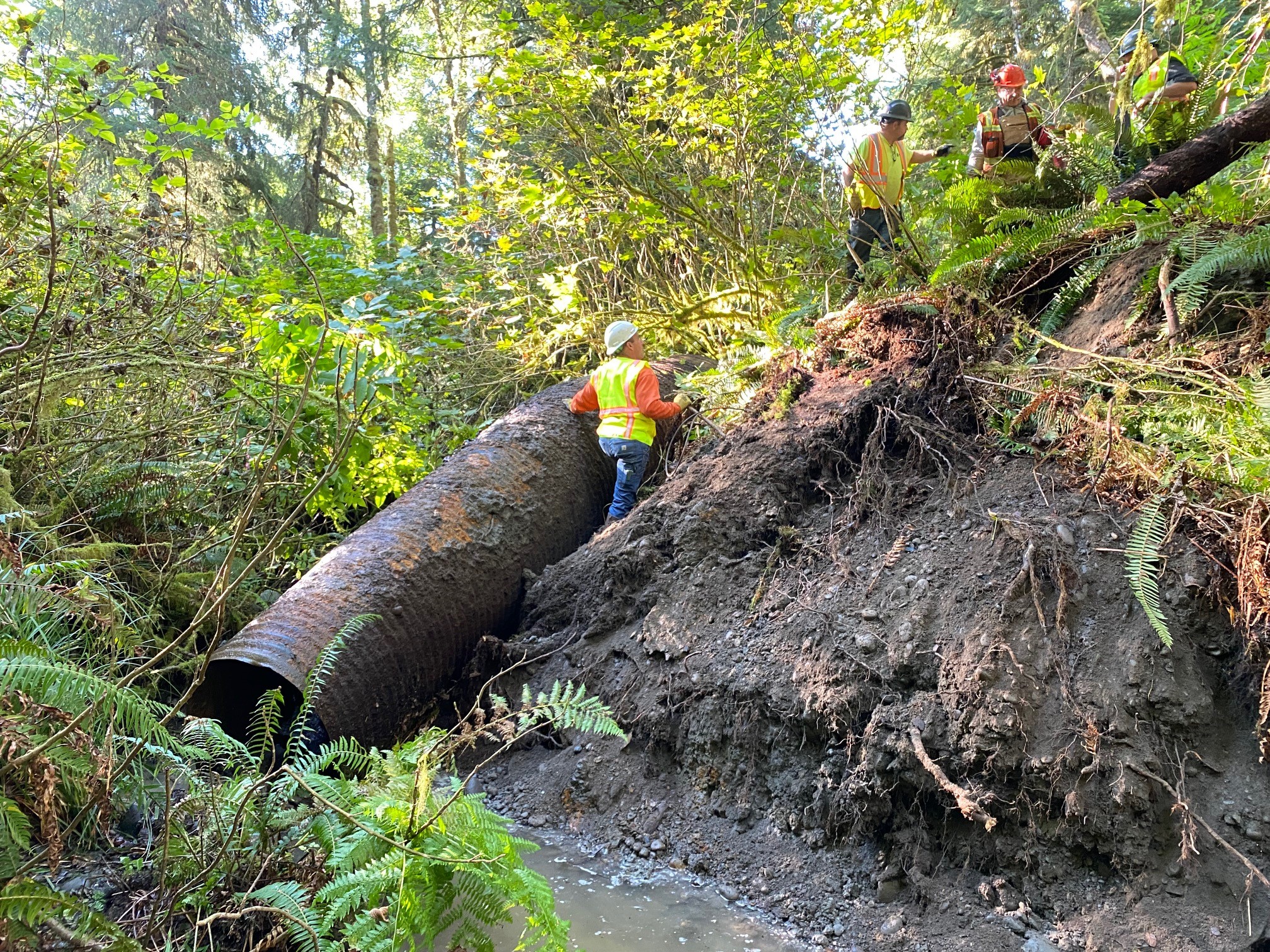
After a road washout, chunks of a culvert landed in Cassel Creek, a tributary to the Hoh River.
Photo courtesy of Luke Kelly with Trout Unlimited.
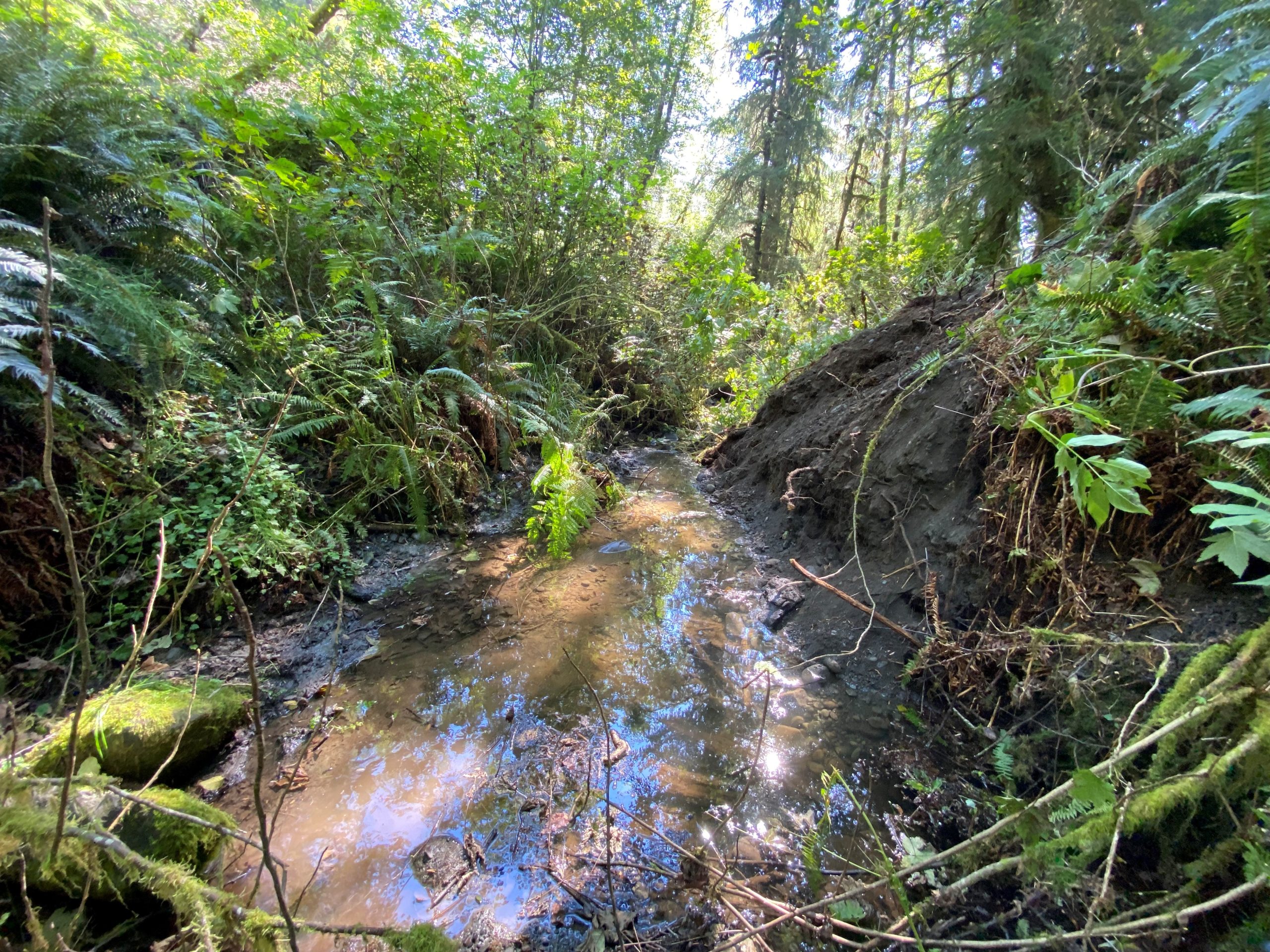
Removing those pieces, a project done by Trout Unlimited, made the creek navigable for fish again.
Photo courtesy of Luke Kelly with Trout Unlimited.
What are we working on now?
Ongoing
- We monitor water quality in streams and rivers year-round to learn how our ecosystems are doing and where fish habitat can be improved. We collect water temperatures, insect abundance, and oxygen, pH, and pollutant levels, in addition to other data. To see what the water levels have been like in the Hoh River recently, check out the gauge.
- In 2024, Hoh Tribe received funding to create a watershed-wide restoration plan. This document will utilize over 20 years worth of data that the Hoh Tribe has been collecting to establish a prioritized list of actions that can be taken to improve the health of the Hoh River and her tributaries
- To learn about the current state of the watershed, read the Hoh chapter of Northwest Treaty Tribes’ State of Our Watersheds Report.
- Members of Hoh Natural Resources are hiking hundreds of river miles throughout the watershed to identify and survey previously unknown barriers that are impeding salmon migration in tributaries of the Hoh River.
- Hoh Natural Resource’s Habitat Restoration Biologist was able to secure funding through the State of Washington’s Salmon Recovery Funding Board to create plans to address the culvert on Ruby Creek. Read more about the project.
Summer 2025
- In July 2025, staff members installed three post-assisted log structures—known as PALS—in a tributary of Braden Creek to improve fish habitat and mitigate destructive erosion imperiling an access road to the Hoh River. These structures are made of natural materials like wood and brush, mimicking the natural recruitment of woody debris typical of Washington’s waterways. By reducing the speed at which water can move through the system, we are increasing the amount of rearing habitat for young salmon and protecting the bank supporting the access road. Check out the installation photos below!
Video courtesy of Maggie Bockart.
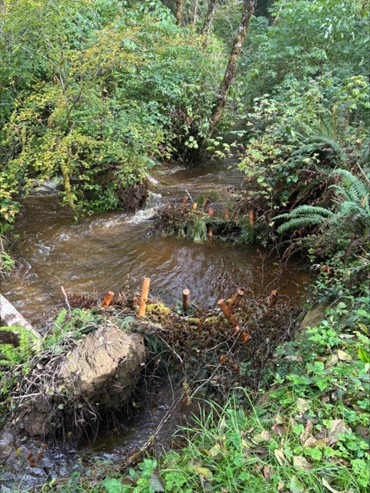
Just two months after implementation day, higher flows began to arrive along with the fall rain. This photo was taken from the road that leads to the Hoh River; you can see how structures #1 and #2 are diverting the bulk of the water energy away from the road towards Braden Creek.
Photo courtesy of Maggie Bockart.
- In August of 2025, Hoh Tribe supported a culvert barrier removal project led by Trout Unlimited on Upper Hoh Road. This project worked to correct a fish barrier and restore anadromy on a tributary to Hell Roaring Creek. This project was completed in October of 2025 with informational signage on the way to highlight the importance of habitat restoration and the protection of treaty assured rights.
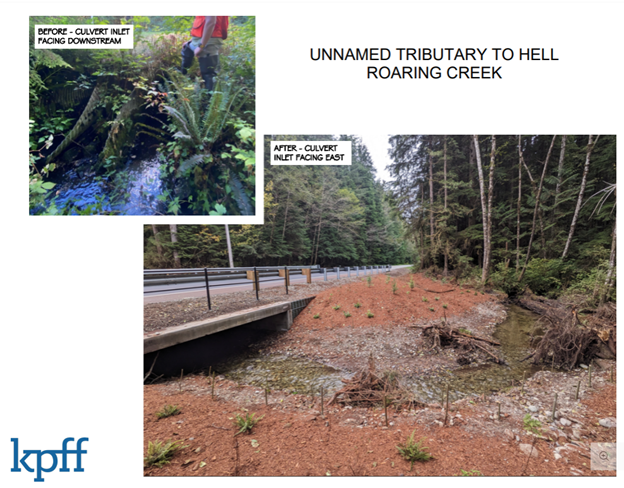
Before and after pictures of the upstream section of the barrier removal project.
Photo courtesy of KPFF.
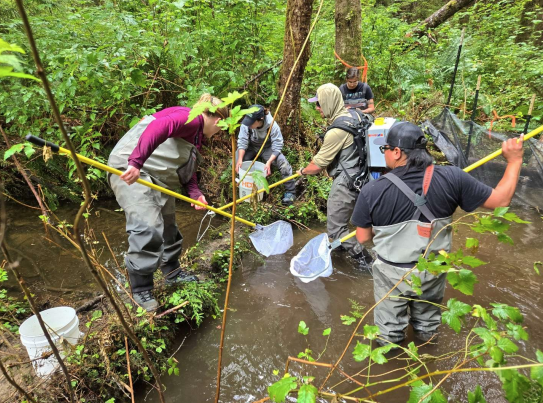
Members of the Hoh Natural Resources department, along with Trout Unlimited biologist Riley Gallagher, electrofishing as part of the de-fishing process that precedes construction implementation. We removed over 100 critters from this small section of the stream, including trout fry, salamanders, lamprey, and sculpin!
Photo courtesy of KPFF.
- In September of 2025, Hoh Tribe was a project partner with Trout Unlimited to install millions of pounds of woody debris in Owl Creek, one of the most wood-starved tributaries of the Hoh River. A lack of wood meant a lack of good habitat and food for salmon, along with hotter water temperatures and more significant destruction during high-water events. A helicopter was used to install engineered log jams (ELJs) to mitigate impact to streamside habitat and allowed implementation to be finished in 8 days!
Restoration Successes
- Since 2003, 10,000 Years Institute has removed thousands of pounds of invasive plants in the Hoh River valley. The result is clear; there are fewer invasives along the Hoh than other coastal rivers.
- The Quinault Indian Nation has installed 102 engineered log jams since 2008. This has built 4 miles of new side channel habitat and it protected roads. Properties that were eroding into the river have since been more stable.
- Dave Hahn restored Eagle Springs, a tributary of the Sol Duc, on his homestead. Working with multiple organizations, he removed a culvert, planted trees, and added gravel. You can see amazing underwater videos of returning coho salmon on his YouTube channel: @kingofsolduc!
- A success for river conservation that shouldn’t be underestimated are the forest practice rule changes in the 1990s that created riparian buffers. These rivers evolved with the biggest trees in the world and removing them was a loss we are still struggling to recover from. Riparian buffers were a step in the right direction.
Some projects see higher fish returns after 1-2 years! Other results, like tree growth and sediment deposition, take more time. Ultimately, communities benefit from restoration for decades with better water quality, reduced flood damage, and more robust animal populations.
Juvenile salmon in Hoh River tributaries.
Video courtesy of Maggie Bockart.
Chinook spawning in Owl Creek.
Video courtesy of Maggie Bockart.
Frequently Asked Questions
Do we need river restoration? I thought the Olympic Peninsula rivers and streams were great!
The fact that we still have some great habitat is exactly why investing in restoration now makes sense. Unlike other regions in WA, we are lucky that a fair amount of the habitat is still intact and runs are strong enough that the Peninsula only has two Endangered Species Act (ESA) listed salmon species. However, we know from Tribal fisherman that fish are smaller in size and abundance than they were decades ago. We believe that river restoration now, while we have runs to conserve and build from, will be more effective than restoration of a smaller and more degraded fish population in the future.
Won’t the rivers heal on their own if we just leave them be?
Preventing harm is essential, but depending on this strategy alone will take too much time. Historic logging practices cut old growth trees along the riverbank and flushed log jams downstream. This in-river wood, an essential part of fish habitat, is now lacking. Because today’s trees along the riverbank are young, it’s difficult for them to withstand high flows and accumulate when they fall in.
Simply waiting for the young trees to mature into old growth will take centuries and, in that time, we anticipate that conditions will get worse. Waters are warming and summer flows are getting lower. Restoration is a powerful tool we have to protect salmon habitat now!
Can restoration work if fish runs are already low?
Yes! We want to support our existing fish runs, no matter the size. Small runs have made impressive comebacks before. Through extensive work on Jimmycomelately Creek, including creating new meanders, replacing a culvert, and removing creosoted pilings, the Jamestown S’kallam Tribe brought double digit summer chum runs into the thousands.
Fish can return if their old stream is improved and they can also find new habitat. Fish have been documented “exploring” neighboring waters. They can detect cues, like water temperature and flow rate, to find good habitat.
Why don’t we just increase hatchery output?
Without restoration, hatchery fish will struggle in the same poor conditions as wild fish. Improved habitat helps both wild and hatchery fish, in addition to all beings dependent on river ecosystems, from insects to humans and birds.
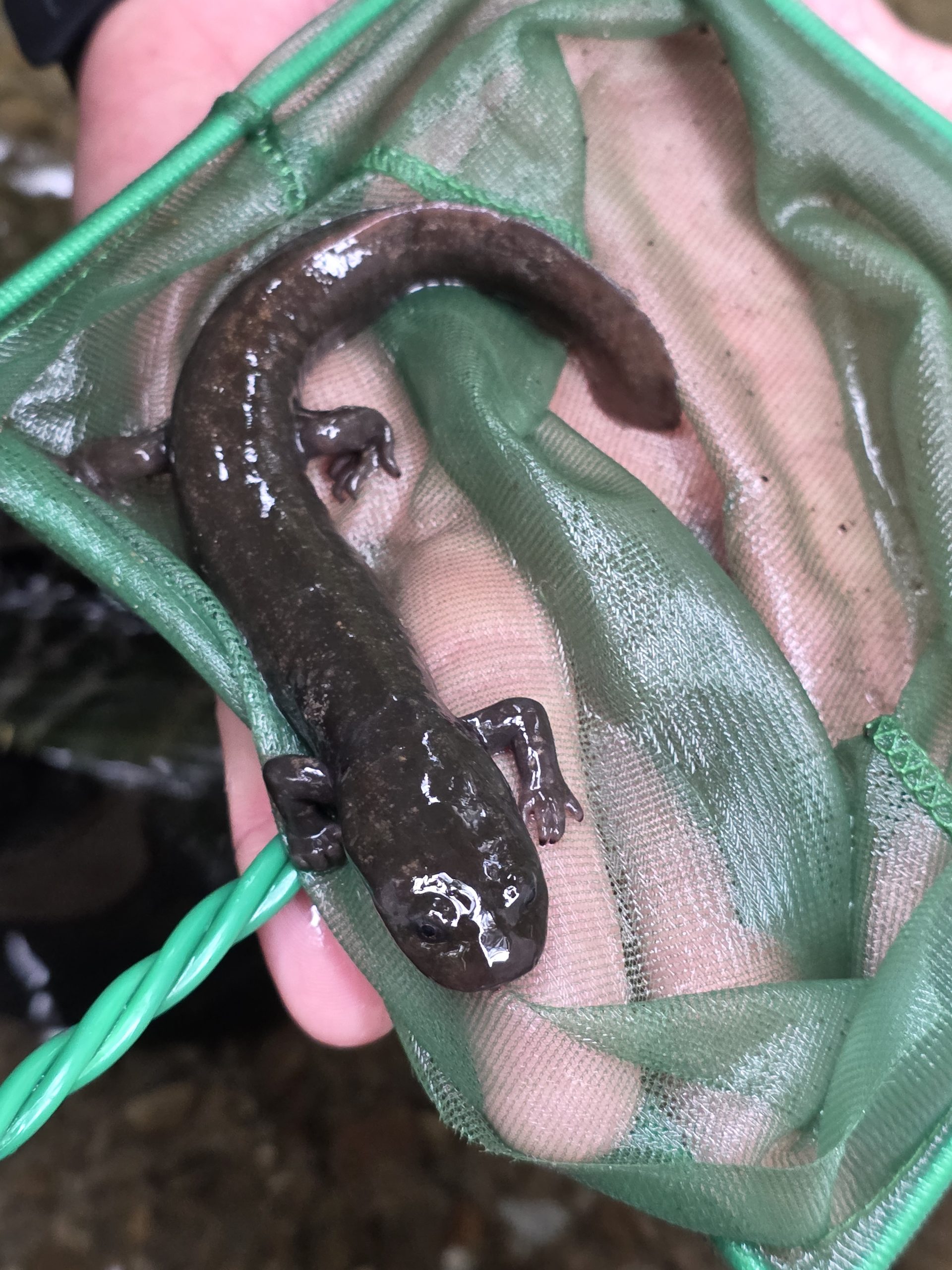
The creeks and rivers in the Hoh U&A are full of life, including this salamander found in a tributary to Hell Roaring Creek.
Photo courtesy of Maggie Bockart.
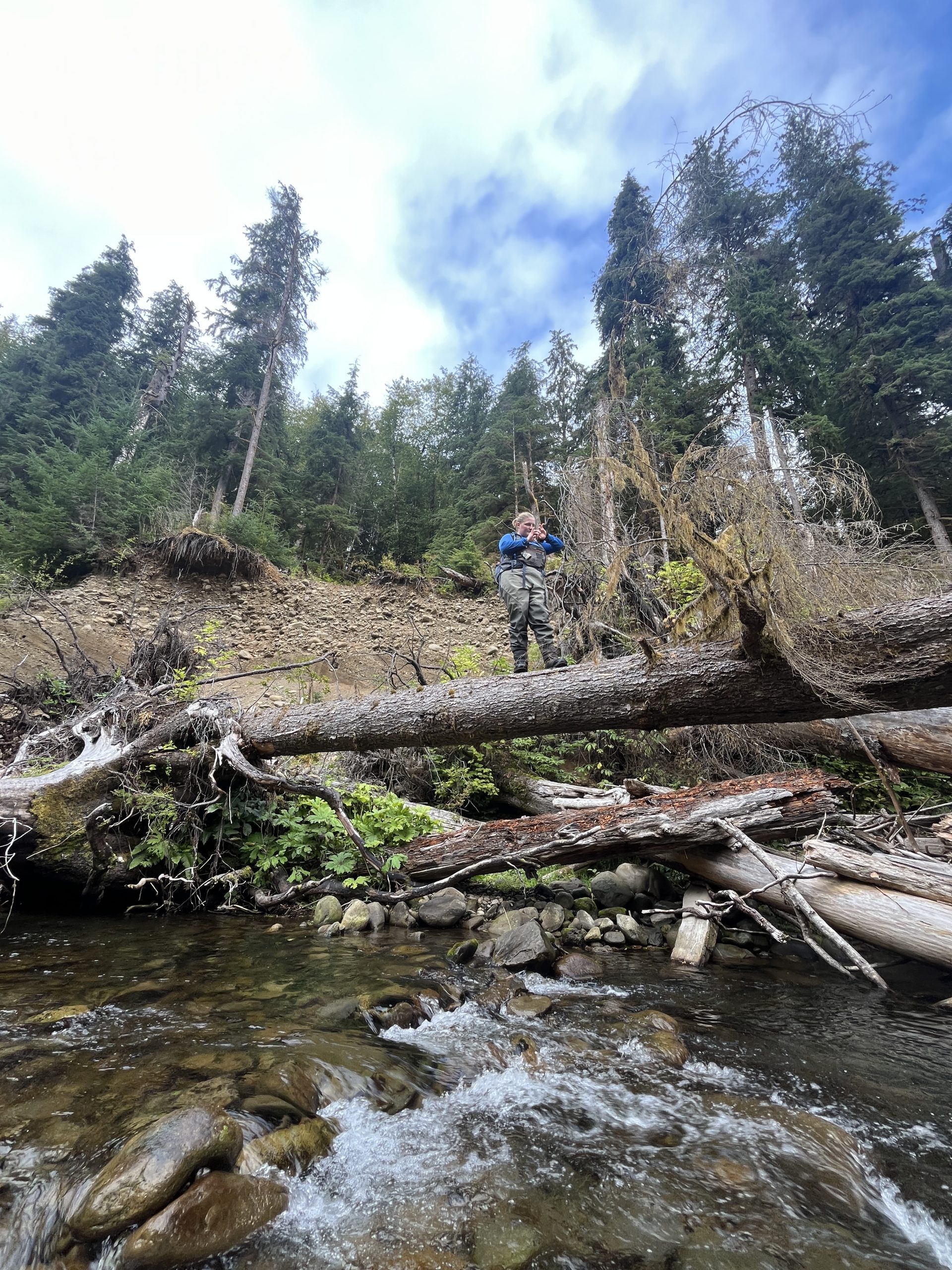
Hoh staff conduct comprehensive habitat surveys to understand conditions throughout the U&A.
Photo courtesy of Maggie Bockart.
Learn more!
We work with other coastal Tribes (Quileute, Quinault, and Makah), Trout Unlimited, the Wild Salmon Center, and Coast Salmon Partnership to identify, prioritize, and implement fish barrier removal projects on the Olympic Coast through the Coldwater Connection Campaign (CWCC). Barriers are prioritized based on the percent of impassability, the quality of upstream habitat, and the length of potential habitat gained following barrier removal. Learn how CWCC reconnects salmonids to upstream cold-water habitat from the Wild Salmon Center. One culvert replaced through the CWCC opened up 5 miles of spawning and rearing habitat; young lamprey were seen using it almost immediately.
Learn more about salmon by listening to Coast Salmon Partnership’s radio public service announcements, Salmon Minutes!
Explore the impacts of the largest barrier removal project on the Olympic Peninsula, the removal of the Elwha River dams. The first winter steelhead returned upstream of the Elwha dam just a few months after it was removed.
Tourism drives a significant amount of the Olympic Peninsula economy. River restoration helps preserve both the natural beauty tourists travel to visit and the infrastructure that supports them. See where tourists spent $284.4 million in Clallam County and $159.9 million in Jefferson County in 2023.
Installation of a culvert at Tributary to Hell Roaring Creek.
Video courtesy of Maggie Bockart.
In October 2025, the Hoh Tribe partnered with Trout Unlimited to install large woody debris in a highly productive tributary of the Hoh River that had lost critical salmon habitat. This video, created by trail camera at one of the installation sites, highlights some of the dramatic changes we are seeing over the course of a few months following implementation.
Video courtesy of Maggie Bockart.